No products in the cart.
March 12, 2026 9:40 pm

Free USA shipping on orders $35+
March 12, 2026 9:40 pm
The study of Germanic symbols within Germanic religion and mythology opens a window into the lived experience of the Germanic people of early northern Europe.
Archaeology, runology, and medieval literary tradition together preserve a layered picture of ancient beliefs, ritual practices, and symbolic expression.
This article draws carefully on academic research to distinguish between what belongs to the ancient Germanic past and what reflects later developments in the modern era.
We for instance have sourced veridical information carefully from the many academic works of the well respected Professor Klaus Düwel, who was a German philologist in Germanic studies at the University of Göttingen, in Germany and a leading expert on this subject.
Understanding these symbols matters. But we must remain cautious as to not project modern wishful thinking and/or modern narratives onto them.
Indeed, they illuminate the cosmology, identity, and social life of the early Germanic world, showing how religious meaning could be carried in writing, ornament, and narrative tradition.
However, cultural and historical context matters and should not be neglected when discussing spiritual or religious ideas expressed through the symbolism found in the archaeological record.
By grounding the discussion in the academic literature, we gain a clearer view of how Germanic culture and Germanic mythology evolved among communities from the Bronze Age to the Viking Age, and into medieval Iceland.
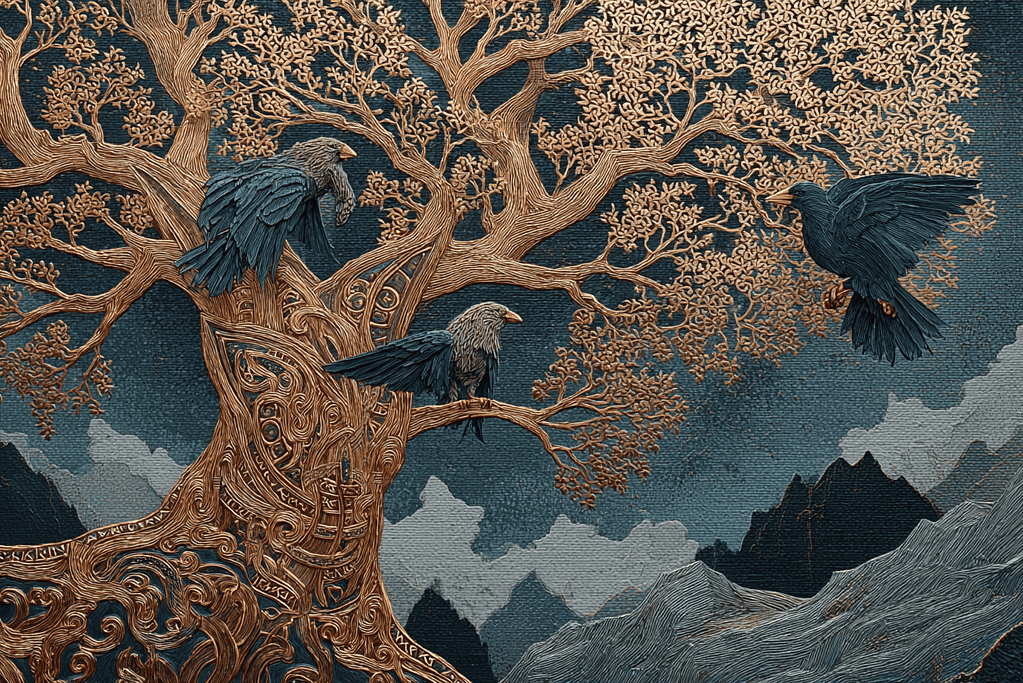
The phrase “germanic symbols” covers several different historical layers. Academic research separates three categories: the runes as a structured writing system, then iconographic motifs on objects, and later drawn talismanic signs preserved in manuscripts.
Each of these belongs to a distinct chronological and cultural setting. (Düwel, 2008, pp. 2–3; Bauer, 2024, pp. 83–84).
Such distinctions are essential for understanding Germanic religion and its development across the Germanic world.
Signs appearing on objects from the Nordic Bronze Age or Iron Age are not automatically connected to runic writing.
In fact, the very term rune in modern German reflects a learned coinage shaped by later scholarly usage rather than direct continuity from ancient germanic peoples. (Düwel, 2008, pp. 2–3).
These terminological clarifications help situate the symbolic vocabulary of Germanic tribes within broader archaeological evidence.
They remind us that symbolic meaning must be reconstructed through careful comparison of inscriptions, objects, and texts rather than assumed from later tradition.
Among the various Germanic sign systems, runic writing stands out as the most securely attested.
The elder futhark script, consisting of twenty-four characters, allowed the Germanic people to preserve speech in durable form.
Early tradition even imagined a divine origin for runes, linking their prestige to sacred knowledge. (Düwel, 2008, pp. 2–4).
Runes likely emerged no later than the first centuries of the Common Era, with early finds concentrated in Scandinavia and adjacent regions.
The Runic symbols, however, may have developed from both Etruscan and Lepontic Scripts.
Originally, they were adopted and further developed via cultural contact of Continental Germanic tribes with the writing systems used e.g. in regions of Switzerland (Lepontic) and Italy (North Etruscan Scripts).
From there, their use spread through movement and exchange among North Germanic and west Germanic groups. (Düwel, 2008, pp. 3–5).
In the context of Germanic religion and mythology, runes could carry social and ritual meaning.
They appear on weapons, jewelry, and everyday objects, suggesting that writing itself became a symbolic marker of status and identity among early Germanic tribes.
The physical distribution of inscriptions offers insight into symbolic life throughout northern europe.
Runes were cut into durable materials such as stone, metal, and occasionally bone or wood.
Portable objects, including coins and amulets, could circulate widely, while rune stones remained fixed in landscape settings. (Düwel, 2008, pp. 5–6).
This pattern reflects broader Germanic religious practices.
Portable signs might accompany individuals into battle or burial, linking personal identity to the pantheon of Germanic gods.
Fixed monuments could mark territories or commemorate the dead, as can be seen in person at The Opfermoor Vogtei, an open-air archaeological museum located in Niederdorla, Thuringia, Germany today.
Such evidence underscores the importance of material culture in reconstructing ancient Germanic spirituality.
Even the depositional context matters. Finds from a bog environment, for example, reveal ritualized offerings that illuminate the symbolic framework of pre-Christian europe.
Debate continues over whether runic inscriptions were primarily magical or practical.
It is highly likely that they were both. Research on Late Roman Iron Age contexts shows that Roman epigraphic traditions influenced early Scandinavian practices.
Some inscriptions may record ownership or craft signatures rather than spells. (Imer, 2010, pp. 41–43, 61–62).
Scholars caution against forcing a magical interpretation when commemoration or social signaling provides a more plausible explanation.
Features sometimes associated with magical inscriptions include charm words, sequences of letters, and other symbolic signs . Yet these must be evaluated within their broader context. (Mees, 2016, pp. 15–16).
Such nuance helps clarify how Germanic belief functioned in daily life. The symbolic use of writing reveals a spectrum of meanings rather than a single ritual purpose.
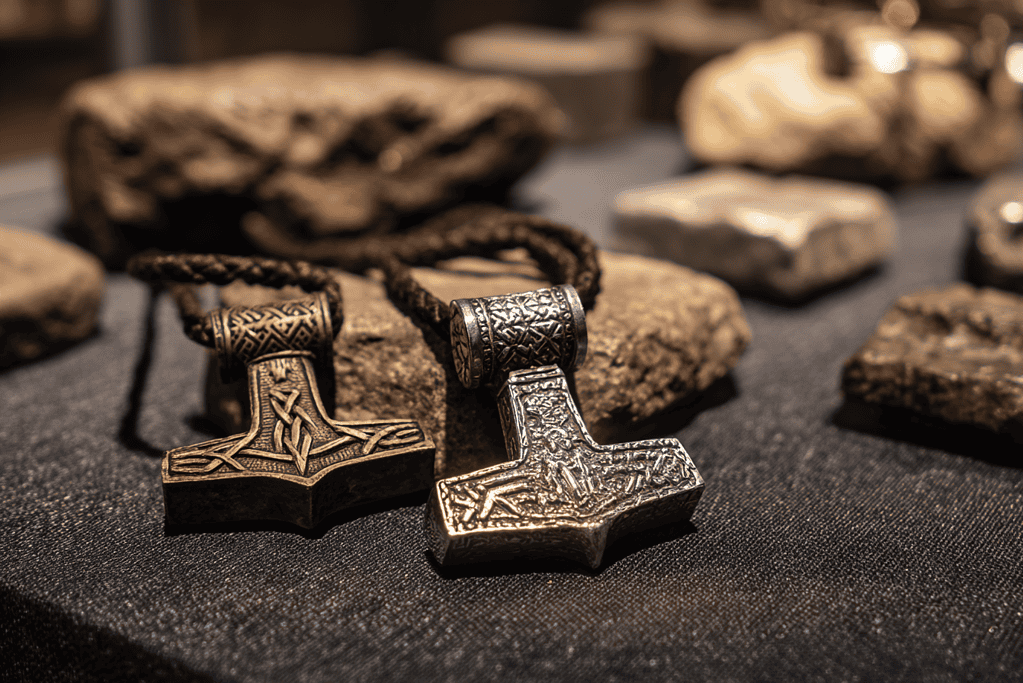
Migration Period gold bracteates offer a vivid example of symbolic convergence. These wearable objects combine imagery, inscription, and ritual function at the same time.
One famous inscription invokes an áss, a member of the divine norse gods, illustrating how religious address could be condensed into a few carved characters. (MacLeod & Mees, 2006, pp. 14–16).
Similar can be said about the Nordendorf Fibulae from North of Augsburg, Bavaria and the Alemannic Pforzen Buckle from the Ostallgäu (Bavarian-Swabia). Both have Runic inscriptions with possible religious connections.
The word alu, was frequently found on bracteates, and has inspired numerous interpretations.
Some scholars connect it with nourishment or intoxicating drink, others with apotropaic protection. The scale of the corpus has made it central to debates about early symbolic language. (Wicker, 2021, pp. 132–133).
These objects reveal how Germanic religious practices intertwined with personal ornamentation. Wearing a symbol could signal affiliation, invoke protection, or express devotion to a particular deity.
The hammer pendant associated with god thor became a defining emblem of the Viking Age.
Archaeological studies show that such pendants were worn around the neck or attached to clothing, suggesting both protective and identity-forming roles. (Staecker, 1999, p. 90).
However, archaeological interpretation has moved beyond viewing the hammer simply as a reaction to Christian symbols. Instead, scholars emphasize its expression of Germanic culture, and religious affiliation.
The pendant articulated belonging within a distinctive worldview rooted in myth and ritual. (Staecker, 1999, pp. 89–92).
Through this symbol, the relationship between thor and communal identity becomes visible.
The material presence of the hammer points to a lived experience of myth among north Germanic peoples.
Medieval old norse literature preserves powerful narratives about runic wisdom, but how much they were influenced by Christian narratives is another problem well known to philologists specialized in this field of inquiry.
In the norse cosmology of the Poetic Edda, god odin acquires the runes through ordeal, hanging wounded on the world tree yggdrasil. This myth functions as a charter for the sacred status of symbolic knowledge. (Bellows, 1936, pp. 60–61).
Other poems describe practical uses for runes, linking them with healing, or childbirth. Such passages suggest that medieval tradition imagined symbolic writing as operative in socially meaningful contexts. (Bellows, 1936, pp. 393–394).
These literary sources form part of the north Germanic record, offering insight into how symbolic practice was remembered or reinterpreted after communities were converted to Christianity.
The “fear-helm” known from eddic narratives illustrates the transformation of symbolic motifs. In heroic myths, the creature Fáfnir wears a fear-inducing object that frightens opponents.
The text attests the power of the symbol without preserving its graphic form. (Bellows, 1936, pp. 365, 377).
Such examples highlight the fluid boundary between narrative symbolism and physical artifacts. Mythological objects may inspire later artistic representation, yet they remain rooted in storytelling rather than archaeology.
Understanding this distinction deepens appreciation of Germanic myth as a living interpretive tradition.
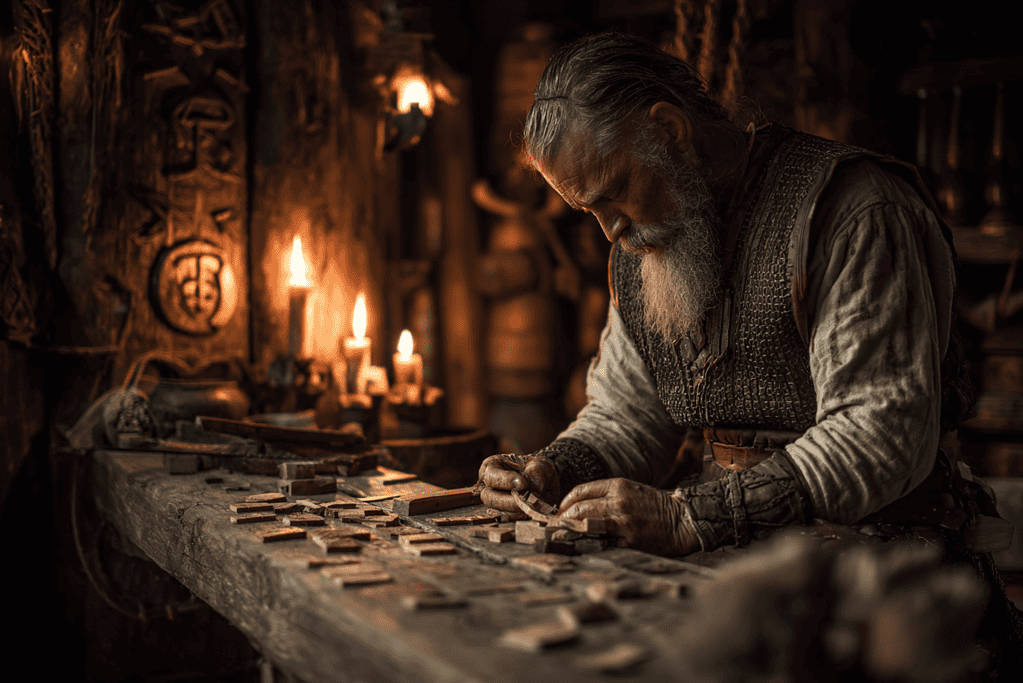
Later Icelandic grimoires introduce a different category of symbols known as galdrastafir.
Academic research dates many of these manuscripts from around the sixteenth century onward and notes their connections to learned European magical traditions. (Pagani, 2025, pp. 241–243). In other words, these symbols are adopted via acculturation.
The development of these staves reflects a process of cultural adaptation.
Over time, graphic form itself became the focal carrier of power, even when ritual context diminished. (Pagani, 2025, pp. 243–244, 253–254).
This chronology complicates assumptions about continuity.
While medieval iceland preserved memories of norse religion, the drawn sigils of later centuries belong to a distinct phase of symbolic creativity.
Careful interpretation requires attention to literature and chronology.
The Saga literature vividly portrays runic magic, yet scholars stress that such motifs may not represent everyday practice in the pre-christian Germanic world. (Bauer, 2024, pp. 92–95).
Likewise, archaeological evidence from objects and inscriptions must be evaluated within specific cultural contexts.
Symbols could signal commemoration, devotion, or identity, and their meaning may shift across time.
By integrating literary, linguistic, and material perspectives, research on Germanic religion and mythology offers a nuanced understanding of symbolic expression among Germanic tribes.
In other words, Germanic symbols belong to several different historical layers, including runic writing as a structured script, visual imagery on objects such as jewelry or stones, and later drawn staves preserved in manuscript traditions.
The elder futhark represents the most securely attested symbolic system shared across early Germanic societies, providing evidence of how writing and symbolic communication functioned in these communities.
Archaeological contexts, on the other hand, including finds of jewelry, rune stones, and ritual deposits, help illuminate how symbols were used in everyday life and in religious settings. Sometimes, their uses may have been magical, although this was by far not always the case.
For instance, amulets and bracteates clearly demonstrate the intersection of inscription, imagery, and devotion, showing how symbolic objects could carry both social and spiritual meaning.
The well known hammer of Thor served as a powerful emblem of identity during the Viking Age, expressing religious affiliation as well as cultural belonging.
Furthermore, Medieval Old Norse texts preserve myths about the acquisition and use of symbolic knowledge, including the famous ordeal of Odin in which he gains the runes.
And last but not least, Icelandic magical staves belong to later early modern developments and should not be treated as direct survivals from ancient Germanic times.
Scholarly analysis therefore places strong emphasis on careful source criticism when reconstructing Germanic belief and religious practices.
Bauer, A. (2024). La « magie runique » et ses protagonistes dans la littérature norroise. Deshima, 18, 79–98.
Bellows, H. A. (Trans.). (1936). The Poetic Edda. Princeton University Press; The American-Scandinavian Foundation.
Düwel, K. (2008). Runenkunde (Neuausgabe; 4., überarb. und aktualisierte Aufl.). J.B. Metzler.
Imer, L. M. (2010). Runes and Romans in the North. Futhark: International Journal of Runic Studies, 1, 41–64.
MacLeod, M., & Mees, B. (2006). Runic Amulets and Magic Objects. The Boydell Press.
Mees, B. (2016). The Hogganvik inscription and early Nordic memorialisation. Futhark: International Journal of Runic Studies, 7, 7–28.
Pagani, R. L. (2025). The Mediterranean origin of the galdrastafir: Tracing the transmission of the learned European magical tradition into Icelandic popular lore. Gripla, 36, 241–269.
Staecker, J. (1999). Thor’s hammer – symbol of Christianization and political delusion. Lund Archaeological Review, 5, 89–104.
Sturluson, S. (1916). The Prose Edda (A. G. Brodeur, Trans.). The American-Scandinavian Foundation.
Wicker, N. L. (2021). Bracteates and beverages: An image from Scalford (and Hoby) and the inscription alu. In M. MacLeod, M. Bianchi, & H. Williams (Eds.), Reading Runes (pp. 127–141). Uppsala University.

ᛉ 100% handcrafted artisan pagan , viking, witchcraft and shamanic inspired jewelry.
ᛉ Runes, Symbolism & European Folklore
Get 20% off👇🏻

Garm barely shows up in the old Norse stories.
Still… he leaves a mark.
A...
Leave a comment with your result ❤️
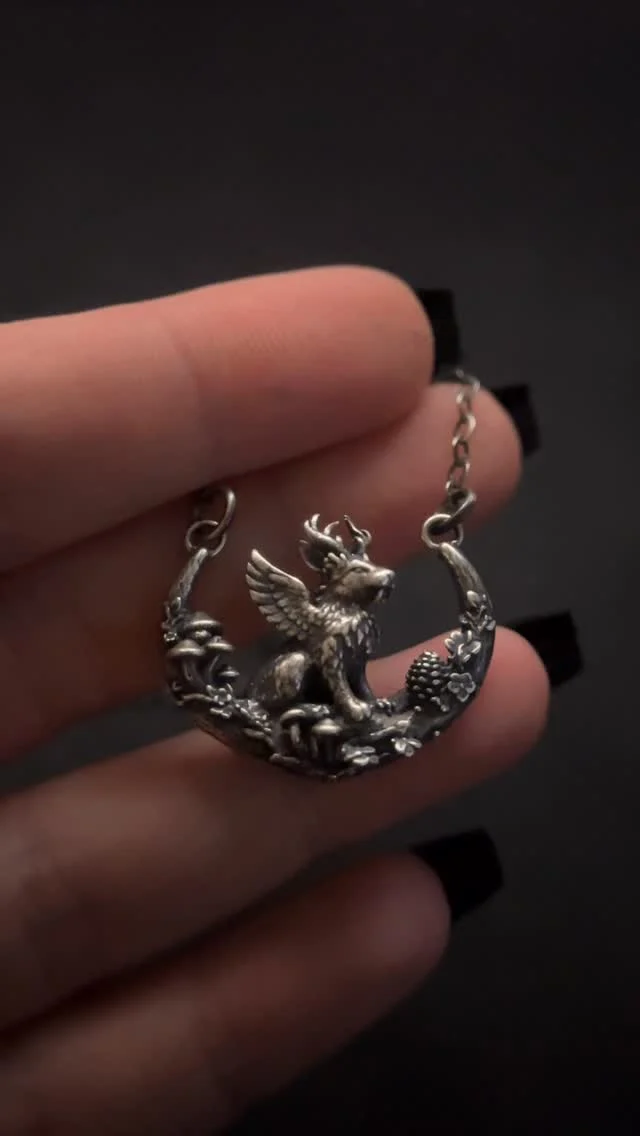
Bavarian Folklore says that you might just cross paths with a Wolpertinger in the alpine...

🐇🌲✨
He finally stepped out of the forest…
The Wolpertinger Pendant has arrived.
Inspired by...

I don’t often sell them, but love it when I do!
Vinca symbol bracelets ❤️...

Rooted in strength + guarded by ravens

The serpent waits 🖤
(Handcrafted Jörmungandr ring made to order in my shop)

Stay warm, everyone ❤️

😑😑😑🤮

I thought I had closed the book on the Alice in Wonderland rings…
But you...

Can this be over now, please?

In case you forgot 💜

Something I’ve been thinking about lately.
If there’s one thing I would’ve done differently early...

This year, we’re not buying things just to keep up.
If you need the reminder:...

My husband is from Bavaria (southern Germany) and I originally made this Krampus pendant for...

Some of the items I’m shipping out today ❤️
Please forgive my dirty nails 😂...

A few items shipping out today 🥰

This mornings rings shipping out ❤️

A few of the rjngs I’m shipping out this morning ❤️
How do you like...

Krampus is coming 🫶🏻

Getting ready to pack up these pretties and ship to their owners ❤️

Freya, cats and pentacles. Doesn’t get any better ❤️

You all got me going crazy making all these fairytale + storybook rings.
But I’ll...

Just launched these pretties ❤️
Size 9 amethyst ring + size 7.25 green kyanite

What would you trade to learn Baba Yaga’s secrets?

It *finally* looks, feels and smells like October!
And here are some items I’m packing...

This mornings pretties getting ready to ship :)

Getting ready to pack up these pretties and ship to their owners ❤️

You bet I’m hopping on this trend 😂
Thank you @shes_sinister for the prompt!

While I welcome the seasonal darkness…it sure is going to make my morning quick videos...

Finally finished the rings I’ve been working on in my stories ❤️
I think I...

Was going to post this update to my stories but it’s too long.

“How do you know I’m mad?” said Alice.
“You must be,” said the Cat, “or...

Some of this mornings orders getting ready to ship. Those little bats are so cute...

Here is the finished ring I was working on in my stories yesterday, along with...

A few of today’s orders shipping out this morning ❤️

The two silver raven rings I was working on in my stories yesterday.
…as well...

Eeeek! I’m so happy to add these to my shop ❤️
I’ve gotten so many...

I had 6 clamshells ready to ship this morning but I dropped and lost my...

Not the story you were told.
The girl didn’t run.
The wolf didn’t win.
This...

I love these raven rings so much 🖤
This mornings pretties shipping out.
All items...

Sleek + minimal Mjölnir ring ⚒️

Today’s orders getting ready to ship.
…And I finally got some time to work on...

That ant ring is so out of place 😂
Not that the mail is coming...

If you had this, which runes would you choose? Or would you accept the runes...


About the author Jacqueline Fatica


