No products in the cart.
March 15, 2026 8:00 pm

Free USA shipping on orders $35+
March 15, 2026 8:00 pm
The figure commonly known in English as Aegir, written Ægir in medieval sources, occupies a fascinating position within norse mythology.
He appears in the surviving Old Norse literary tradition as a maritime being associated with the ocean, divine feasting, and poetic language.
Rather than functioning as a clearly defined deity in the manner of Odin or Thor, he represents a powerful mythic presence that also personifies the sea.
Studying this figure helps illuminate how medieval Scandinavians understood the natural world and expressed those ideas through myth and poetry.
The literary sources show that the sea giant was imagined as both a social host of the gods and a symbolic embodiment of maritime danger.
His stories reveal how mythological narrative and poetic expression worked together in the cultural imagination of the Viking Age and later medieval period.
In medieval Scandinavian literature, the figure anglicised as Aegir appears as a maritime being closely associated with the ocean.
He is sometimes described as a norse god of the sea, yet the texts portray him more precisely as a mythic jötunn who interacts with divine society.
Professor John Lindow notes that he participates in social exchanges with the norse gods without being fully counted among the Æsir, which reflects the fluid boundaries between cosmic groups in myth (Lindow, 2001, pp. 3–4).
The old norse record also preserves alternative poetic names for him, including Hlér, which functioned as a synonym for the sea in skaldic verse.
Professor Rudolf Simek explains that such names show how mythological figures could operate simultaneously as characters and as symbolic expressions of natural forces (Simek, 2007, pp. 1–2).
Through this dual role, he becomes a literary personification of the sea rather than a simple narrative protagonist.
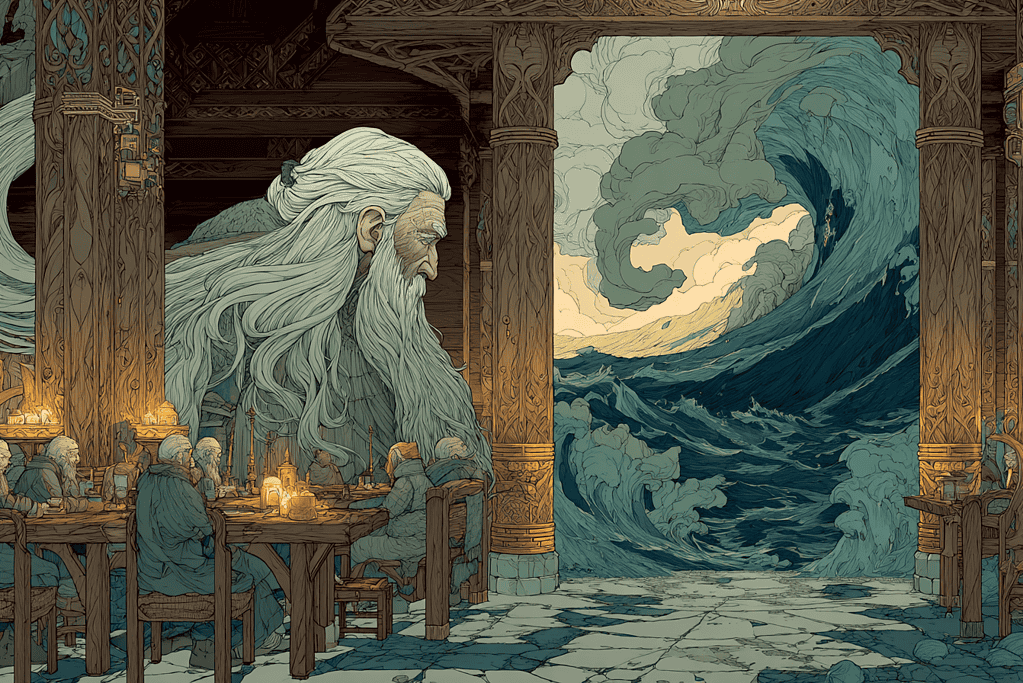
Modern summaries sometimes label him a god of war, yet medieval sources do not present him in this capacity.
Margaret Clunies Ross emphasizes that his narrative importance lies in social and poetic contexts rather than martial activity (Clunies Ross, 1994, pp. 84–88).
He is portrayed as a maritime host and symbolic force rather than a battlefield figure.
This distinction helps clarify the complexity of mythic categories.
The sea could be linked with voyage and conflict, yet the character himself functions mainly as a ritual host and mythic intermediary. Understanding this nuance is essential when interpreting mythological texts.
The sea in norse mythology was imagined as both life-giving and destructive. Coastal societies depended on maritime travel and fishing, yet storms and shipwrecks were constant threats.
British scholar Hilda Ellis Davidson observes that mythic beings connected with the ocean often expressed this dual nature through narrative symbolism (Davidson, 1990, pp. 132–135).
In literary sources, Ægir and Rán form a mythic household that represents these forces.
His wife Rán is described as capturing drowning sailors in her net, reinforcing the idea that the sea could claim human lives. Together they illustrate how medieval audiences understood the ocean as an active and unpredictable power.
Most surviving information about this figure comes from the Poetic Edda and the Prose Edda.
These medieval compilations preserve mythic material that likely circulated orally for centuries.
Turville-Petre stresses that such texts provide the main framework through which modern scholars reconstruct Norse myth (Turville-Petre, 1964, pp. 42–44).
In the Prose Edda, Snorri Sturluson records that Rán have nine daughters associated with wave-movement.
The passage lists poetic names for waves, showing how myth and metaphor were closely connected (Sturluson, 1998, pp. 95–97). These daughters of Ægir demonstrate how natural phenomena were understood through familial imagery.
One of the most memorable aspects of this maritime being is that he was known for hosting gatherings of the gods.
Snorri describes a magnificent hall illuminated with shining gold that functioned like firelight. This narrative detail explains why poets later described gold metaphorically as the “fire of the sea” (Sturluson, 1998, pp. 33–35).
Such feasts highlight the importance of hospitality in mythic society.
Even Odin’s presence at these gatherings shows that divine relationships extended beyond rigid social divisions. The sea-host thus serves as a mediator between cosmic communities.
The Eddic poem Hymiskviða presents a narrative in which the gods require him to provide drink for their assemblies.
He agrees on the condition that a suitable vessel be obtained, leading Thor and Týr to seek a great cauldron from the giant Hymir. Their journey includes perilous maritime encounters and tests of strength (Larrington, 2014, pp. 78–81).
When the cauldron is secured, the gods are finally able to brew ale for winter feasts at his hall.
This story demonstrates how his presence shapes mythic action even when he is not the central protagonist. The episode underscores the importance of ritual gathering in the mythic worldview.
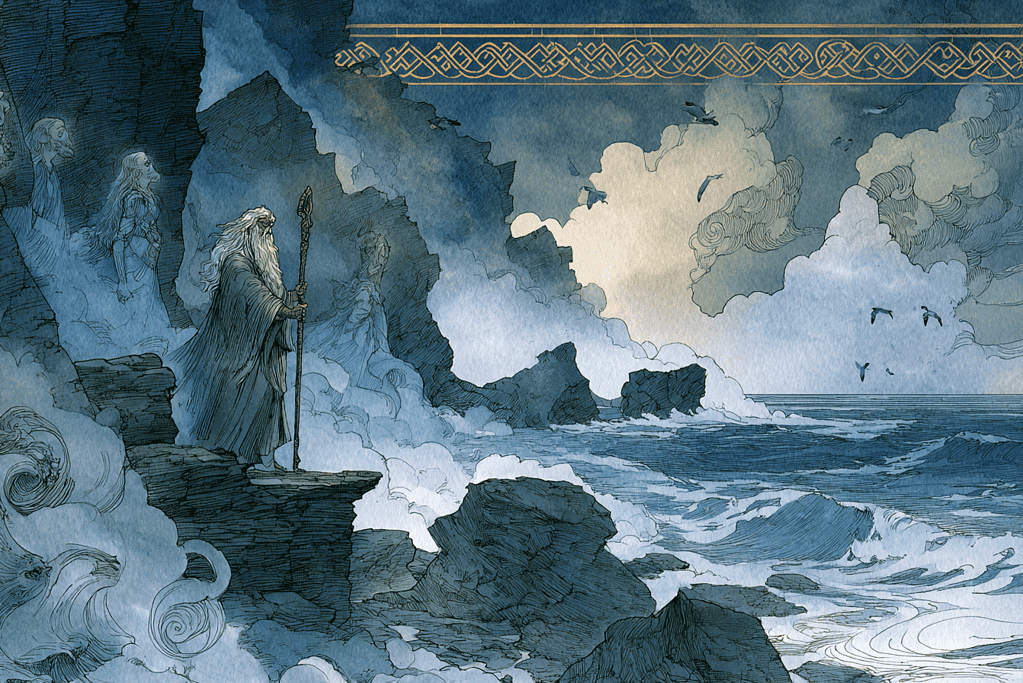
Another important narrative appears in Lokasenna, where the maritime hall becomes the setting for dramatic confrontation.
The prose introduction describes attendants named Fimafeng and Eldir, whose praise provokes Loki to violence.
The text recounts that Loki kills Fimafeng, triggering a ritual exchange of insults among the assembled gods (Larrington, 2014, pp. 85–89).
This episode illustrates the symbolic role of feasting as a marker of social order. The disruption of the banquet reflects tensions within the divine community and highlights the liminal position of the sea-host himself.
The mythic household includes nine daughters who personify the movement of waves.
Snorri provides poetic names such as Bylgja, Dúfa, Blóðughadda, Hefring, and Himinglæva, emphasizing the connection between myth and environmental observation (Sturluson, 1998, pp. 95–97).
These figures demonstrate how natural processes were imagined through kinship structures.
The image of waves as feminine beings reflects a wider symbolic pattern. Maritime danger and beauty are expressed simultaneously through the idea of a family inhabiting the ocean.
The instructional dialogue of Skáldskaparmál shows how mythological stories were used to explain poetic technique.
Anthony Faulkes explains that Snorri framed his work as a guide to understanding metaphor and concealment in verse (Faulkes, 1998, pp. 11–14).
References to maritime imagery thus became integral to the development of skaldic poetry.
Through this literary tradition, the sea-host remained a vivid presence in medieval imagination. His myth illustrates how narrative and linguistic creativity were intertwined in Scandinavian culture.
There is no direct archaeological proof that sacrifices were made specifically to this figure. Scholars agree that he is primarily attested in literary sources.
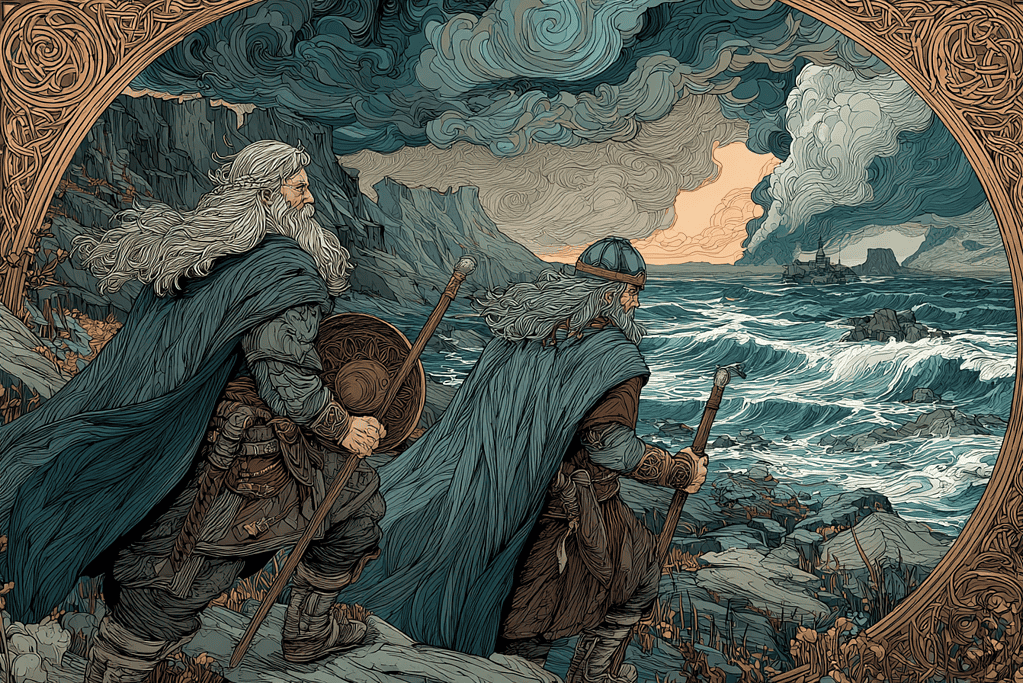
However, maritime myth themes such as Thor’s fishing expedition appear in Viking-Age art, showing that ocean-related narratives were culturally widespread (Simek, 2007, p. 322).
In other words, this evidence strongly suggests that myths about the sea formed part of a broader symbolic system rooted in everyday experience. And the figure itself therefore represents cultural memory rather than a clearly documented cult.
Clunies Ross, M. (1994). Prolonged echoes: Old Norse myths in medieval Northern society (Vol. 1). Odense University Press.
Davidson, H. R. E. (1990). Gods and myths of Northern Europe. Penguin.
Faulkes, A. (1998). Snorri Sturluson and the Edda. Viking Society for Northern Research.
Larrington, C. (Trans.). (2014). The Poetic Edda. Oxford University Press.
Lindow, J. (2001). Norse mythology: A guide to the gods, heroes, rituals, and beliefs. Oxford University Press.
Simek, R. (2007). Dictionary of Northern mythology (A. Hall, Trans.). D. S. Brewer.
Sturluson, S. (1998). Edda (A. Faulkes, Trans.). Everyman.
Turville-Petre, E. O. G. (1964). Myth and religion of the North. Holt, Rinehart and Winston.

ᛉ 100% handcrafted artisan pagan , viking, witchcraft and shamanic inspired jewelry.
ᛉ Runes, Symbolism & European Folklore
Get 20% off👇🏻
Happy washing day 🙃
A few rings I’ve worked on the last couple days…
Freya’s cats rule and dogs drool?
Or was that the other way around? 🙃

Garm barely shows up in the old Norse stories.
Still… he leaves a mark.
A...
Leave a comment with your result ❤️
Bavarian Folklore says that you might just cross paths with a Wolpertinger in the alpine...

🐇🌲✨
He finally stepped out of the forest…
The Wolpertinger Pendant has arrived.
Inspired by...

I don’t often sell them, but love it when I do!
Vinca symbol bracelets ❤️...

Rooted in strength + guarded by ravens

The serpent waits 🖤
(Handcrafted Jörmungandr ring made to order in my shop)

Stay warm, everyone ❤️

😑😑😑🤮

I thought I had closed the book on the Alice in Wonderland rings…
But you...

Can this be over now, please?

In case you forgot 💜

Something I’ve been thinking about lately.
If there’s one thing I would’ve done differently early...

This year, we’re not buying things just to keep up.
If you need the reminder:...

My husband is from Bavaria (southern Germany) and I originally made this Krampus pendant for...

Some of the items I’m shipping out today ❤️
Please forgive my dirty nails 😂...

A few items shipping out today 🥰

This mornings rings shipping out ❤️

A few of the rjngs I’m shipping out this morning ❤️
How do you like...

Krampus is coming 🫶🏻

Getting ready to pack up these pretties and ship to their owners ❤️

Freya, cats and pentacles. Doesn’t get any better ❤️

You all got me going crazy making all these fairytale + storybook rings.
But I’ll...

Just launched these pretties ❤️
Size 9 amethyst ring + size 7.25 green kyanite

What would you trade to learn Baba Yaga’s secrets?

It *finally* looks, feels and smells like October!
And here are some items I’m packing...

This mornings pretties getting ready to ship :)

Getting ready to pack up these pretties and ship to their owners ❤️

You bet I’m hopping on this trend 😂
Thank you @shes_sinister for the prompt!

While I welcome the seasonal darkness…it sure is going to make my morning quick videos...

Finally finished the rings I’ve been working on in my stories ❤️
I think I...

Was going to post this update to my stories but it’s too long.

“How do you know I’m mad?” said Alice.
“You must be,” said the Cat, “or...

Some of this mornings orders getting ready to ship. Those little bats are so cute...

Here is the finished ring I was working on in my stories yesterday, along with...

A few of today’s orders shipping out this morning ❤️

The two silver raven rings I was working on in my stories yesterday.
…as well...

Eeeek! I’m so happy to add these to my shop ❤️
I’ve gotten so many...

I had 6 clamshells ready to ship this morning but I dropped and lost my...

Not the story you were told.
The girl didn’t run.
The wolf didn’t win.
This...

I love these raven rings so much 🖤
This mornings pretties shipping out.
All items...

Sleek + minimal Mjölnir ring ⚒️

Today’s orders getting ready to ship.
…And I finally got some time to work on...


About the author Jacqueline Fatica


